

To use a coffee aroma kit, work in a neutral, odour-free space when your nose is fresh, open one vial at a time and inhale gently rather than sniffing hard, read the name and tie it to a personal memory, and stop after six or eight vials before fatigue sets in. Then brew a cup and look for what you just studied. Short, regular sessions build recognition far faster than long ones.
Quick answer
- Where: a quiet space free of perfume, food and smoke. Early in the day is best.
- How: hold the vial a few centimetres below the nose and breathe gently. A soft, steady breath carries aroma more accurately than a hard sniff.
- How many: six to eight vials per session, no more. The nose tires quickly.
- The key step: connect each aroma to a memory. Association is what makes a scent stick.
- Then: brew a coffee and find those aromas in the cup. That is where the training becomes useful.
What is a coffee aroma kit?
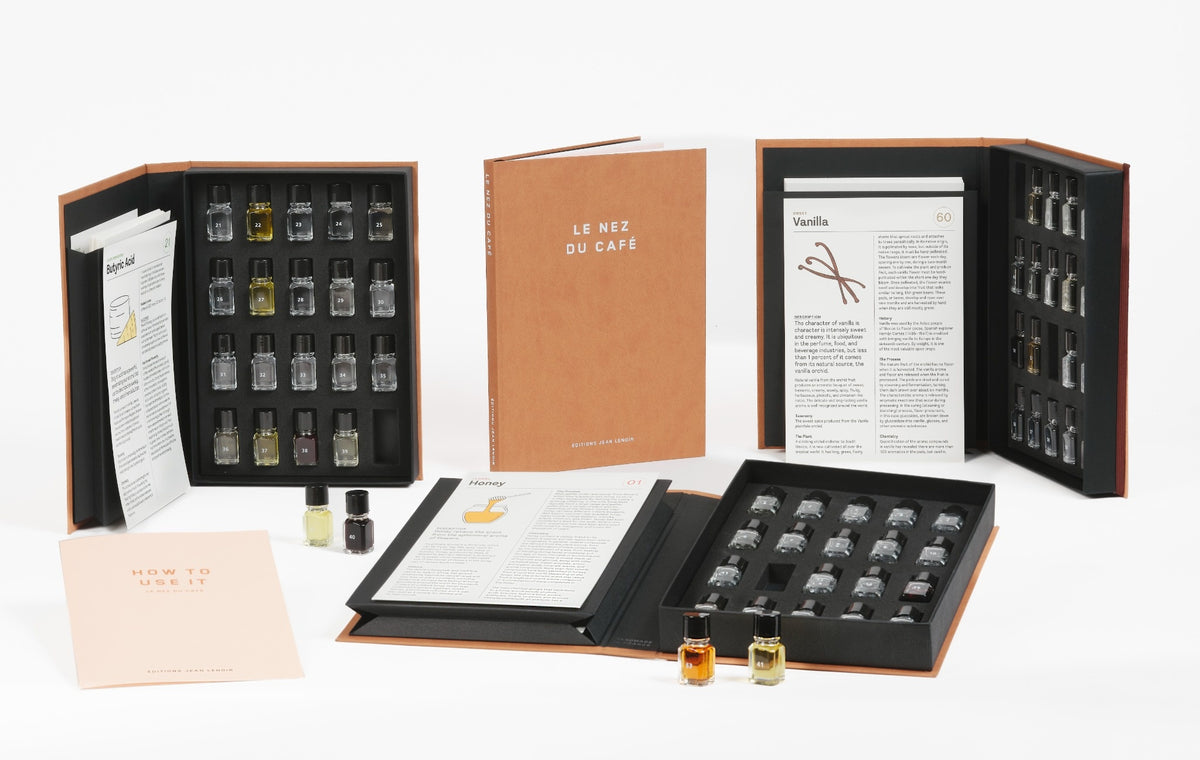
 A coffee aroma kit is a curated collection of scent vials, each recreating a specific aroma found in coffee — from fruity and floral notes to roasted, spiced and earthy ones. Think of it as a reference library for your nose. Instead of vaguely sensing that a coffee is fruity, you learn which fruit, and you recognise that same note the next time you meet it.
The reason it works comes down to how we perceive flavour. The tongue detects only a few basic tastes; everything else we call flavour is aroma, picked up by the nose both directly and retronasally as we drink. Since coffee contains hundreds of aromatic compounds, training your sense of smell is the most effective way to deepen your appreciation of it. Our overview of coffee aroma kits covers the why; this guide covers the how.
How to use a coffee aroma kit, step by step
 Getting value from a kit is less about memorising and more about building associations.
Start neutral. Work in an environment free from competing smells — perfume, food, smoke — and when your nose is fresh. Early in the day is ideal.
Inhale gently. Open a single vial, hold it a few centimetres below your nose and breathe softly. Resist the urge to sniff hard; a steady breath carries aroma more accurately.
Tie it to a memory. Read the name and let it trigger something specific — the blackcurrant of a childhood garden, the toast of a Sunday breakfast. Aroma is deeply tied to memory, and those associations are what make a scent stick.
Stop before fatigue. Work through a handful of vials per session, pause, breathe neutral air, and stop while your attention is still sharp. Quality beats quantity.
From the kit to the cup
The real value appears when you connect the kit to actual coffee. Once you are familiar with a set of aromas, brew a cup and taste deliberately. Ask which of the aromas you have trained appear in the cup — the citrus you smelled earlier, the caramel, the roasted hazelnut. At first you may catch one or two. With practice you will identify layers you never noticed, and you will have the words to describe them.
This is exactly how professionals train. Cuppers and Q Graders use a shared aromatic vocabulary so that a jasmine, blackcurrant and honey note means the same thing in Bogotá as in Berlin. An aroma kit gives you access to that same language.
Four ways to train faster
Be consistent. Short, regular sessions beat occasional marathons. Ten minutes a few times a week builds real recognition.
Test yourself blind. Have someone present the vials without labels, or number them, and try to identify each one. This is where learning accelerates.
Group by family. Fruity, floral, roasted, spicy, earthy. Learning aromas in families helps you place new ones you have never met.
Keep the vials sealed. Close them promptly and store away from heat and light to preserve the aromas for years.
Which kit should you start with?
For most enthusiasts and professionals beginning their sensory journey, the Le Nez du Café 36 Révélation covers the essential spectrum and is a superb foundation. For the most complete training tool available — and the full complexity of both Arabica and Robusta — the Le Nez du Café 2.0 with 60 aromas is the definitive reference, validated by the Coffee Quality Institute and aligned with SCA standards. Our full review of the 2.0 breaks down what is inside and who it is for.
Frequently asked questions
How often should I train with a coffee aroma kit?
Ten to fifteen minutes, two or three times a week. Recognition is built by repetition spaced over time, not by long sessions. A month of short sessions changes how you taste.
How many aromas can I smell in one session?
Six to eight. Beyond that the nose adapts and discrimination drops sharply, so the extra vials teach you nothing.
Should I smell blind or read the label first?
Blind, always, once you have done a first pass. The gap between your guess and the answer is where the learning happens; reading first removes it.
Do the aromas expire?
They are guaranteed for five years and can last up to ten if the vials are closed promptly and kept away from heat and direct light. Storage matters more than age.
Can I train without buying a kit?
Partly — smelling real ingredients helps. What a kit adds is isolation and consistency: a real strawberry smells different every time, while a vial is identical on every occasion, which is what makes the reference reliable.
Does this work for tea or wine too?
The method transfers completely; the aromatic families do not. Each drink has its own reference kit, which is why many people who own one end up buying another. See our guide to wine aroma kits.
Start training your nose
A coffee aroma kit turns drinking coffee into reading it, note by note. Train little and often, connect each aroma to a memory, and always bring it back to the cup.
Share:
The Right Glass for Every Wine: A Guide to Shapes, Crystal & Craft
Le Nez du Vin: The Perfect Gift for the Wine Lover Who Has Everything