
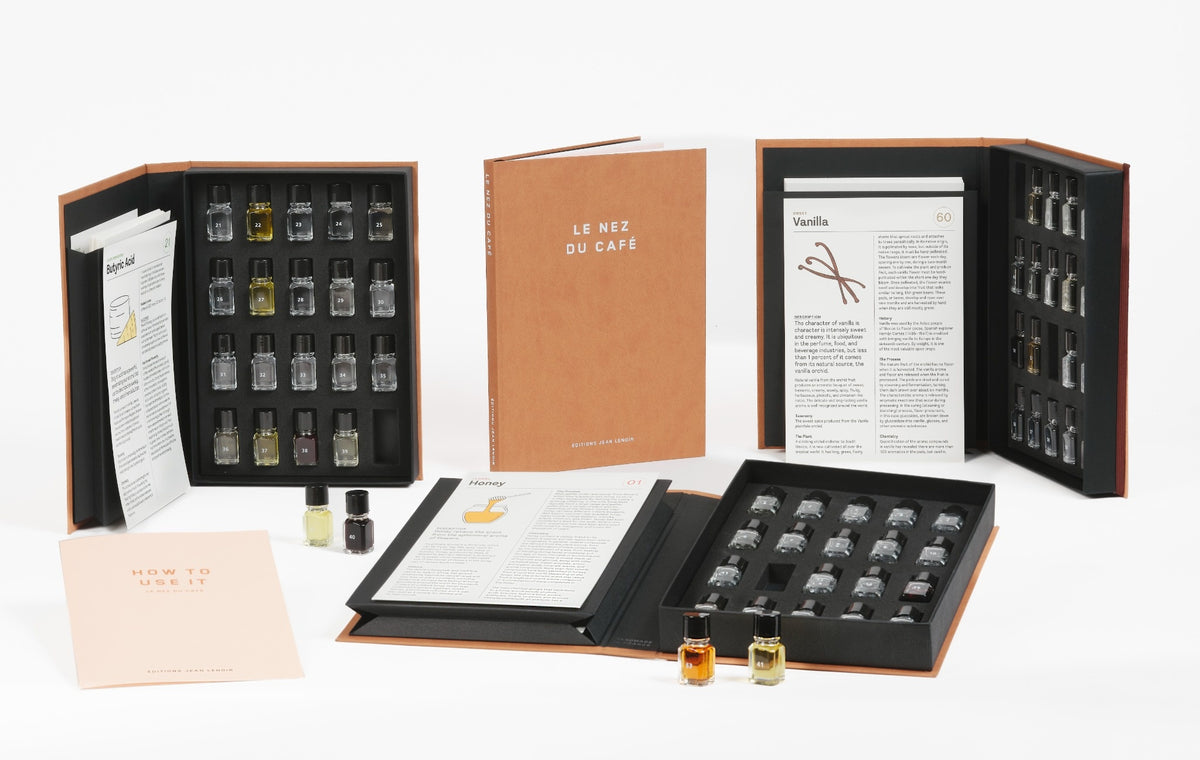
A wine aroma kit is a set of vials, each containing a single isolated scent found in wine — black cherry, violet, green pepper, vanilla, leather. You smell each one, name it, and memorise it, building an olfactory reference library you carry to every glass. It is the fastest way to learn to identify what you are smelling in a wine, and the tool sommeliers, WSET students and wine educators use to do exactly that.
Quick answer
- What it is: vials of isolated wine aromas, with a guidebook linking each to grape varieties and regions.
- Why it works: the nose recognises scents far more easily than it recalls them. Repetition turns recognition into recall.
- How to use it: smell blind first, guess, then check the label. Short sessions beat long ones.
- Which to buy: 6 or 12 aromas to start, 24 for WSET Level 2, 54 for the complete reference.
- Does it contain alcohol? No. The vials hold aromatic essences on a neutral base and nothing in a kit is drinkable.
What is a wine aroma kit?
 Wine is far more than a drink. The tongue detects only a few basic sensations — sweet, acid, bitter, salt, and the tactile grip of tannin. Almost everything else we call flavour is aroma, perceived retronasally as we drink. That is why learning to identify aromas is the single skill that most transforms how you taste.
The principle behind a kit is simple but powerful. Our sense of smell recognises scents far more easily than it recalls them on demand — you know a smell instantly, yet struggle to name it. By smelling an isolated aroma repeatedly, in a controlled and reproducible form, you close that gap. You build a mental catalogue, and when the scent later appears in a glass, your nose recognises it and the word arrives with it.
How to use a wine aroma kit
Work in a neutral space. Choose a quiet, odour-free environment where nothing competes with the aromas. No coffee, no cooking, no perfume.
Smell blind first. Take a vial without reading the label. Inhale slowly and deliberately, then try to name the scent — or at least place it in a family: fruity, floral, vegetal, spicy, animal, empyreumatic. Check the label afterwards. That gap between guess and answer is where the learning happens.
Make connections. Relate each aroma to a memory: fresh berries from a specific summer, a garden after rain, warm spice from a kitchen. Associations are what make scents stick, far more than repetition alone.
Bridge kit and glass. After a session, open a bottle and look for what you have just studied. A wine that once seemed simply fruity will begin to reveal its layers. Our piece on the aromas of Spanish and French wines is a good place to start applying it.
Keep sessions short. The nose tires quickly — after six or eight vials, discrimination drops sharply. Fifteen minutes twice a week beats two hours once a month.
Which wine aroma kit should you choose?
Two houses dominate the category and they answer different needs. The table below compares them by what you are actually trying to do.
| If you are… | Choose | Aromas |
|---|---|---|
| Buying a first kit or a gift | Le Nez du Vin, The Nose Knows | 6 |
| Focused on one style | Le Nez du Vin, Red or White | 12 |
| Studying WSET Level 2 | Le Nez du Vin, Duo Kit | 24 |
| Sommelier or WSET Level 3+ | Le Nez du Vin, Master Kit | 54 |
| Learning to spot wine faults | Le Nez du Vin, The Faults | 12 |
| Wanting breadth for less | Tasterplace | 12, 24, 72 |
Le Nez du Vin — the reference standard
Created by French expert Jean Lenoir in 1981, Le Nez du Vin is the world's benchmark wine aroma kit, used by sommeliers and educators for over four decades. Our complete guide to Le Nez du Vin compares every kit in the range in detail. The 54-aroma Master Kit is the complete reference; the 24-aroma Duo Kit covers the essentials of reds and whites; and focused 12-aroma kits let you explore reds, whites and champagne, oak ageing, or wine faults. Every kit is produced in France and the aromas are guaranteed for five years.
Tasterplace — accessible and versatile
 Tasterplace kits are a more accessible route into sensory training, with sets covering red and white wine aromas in 12, 24 and 72-aroma formats. The range also extends well beyond wine, into beer, chocolate, olive oil and Prosecco, which makes it a good choice if your curiosity is broader than the glass. The 72-aroma Master Kit in particular offers remarkable breadth at an approachable price point.
If coffee is your other passion, the same method applies — see coffee aroma kits explained. And to give a kit rather than buy one, our guide to gifts for wine lovers works through the choice by recipient.
Frequently asked questions
Do wine aroma kits actually work?
Yes, with the caveat that they train recognition and vocabulary rather than taste itself. What changes is your ability to name what you perceive — and naming it is what makes it memorable. Most people notice a difference within a few weeks of short, regular sessions.
How long do the aromas last?
Le Nez du Vin aromas are guaranteed for five years and can last up to ten if the vials are kept closed, away from heat and out of direct light. Storage matters more than age.
Do aroma kits contain wine or alcohol?
No. The vials hold aromatic essences on a neutral base. There is no wine and no alcohol in any kit, and nothing in them is drinkable.
Are wine aroma kits useful for WSET students?
Very. The 24-aroma Duo Kit covers the aromatic vocabulary expected at Level 2, and the 54-aroma Master Kit is the reference most candidates use from Level 3 through Diploma.
How many aromas do I actually need?
More is not automatically better. Six or twelve aromas studied properly beat fifty-four opened once. Start with a focused kit if you are new; buy the Master Kit if you are studying formally or already tasting regularly.
Can I use a kit without any wine training?
Yes. Every kit comes with an illustrated guidebook written to be followed with no prior background, and the method is simply repetition over time.
Why it is worth it
A trained nose changes everything about how you drink. You gain the vocabulary to describe what you taste, the confidence to trust your own perception, and the ability to recognise grape varieties and regions from the glass alone. Above all, the pleasure of every bottle deepens — because you are no longer drinking past the aromas, but reading them.
Wine aroma kits are available at Wine World Tasters with worldwide shipping and a 60-day return policy. Not sure which kit suits you best? Contact us — we are happy to help.
Share:
Coffee Aroma Kits: How to Train Your Nose for Specialty Coffee
Le Nez du Vin: The Complete Guide to Wine Aroma Kits by Jean Lenoir