
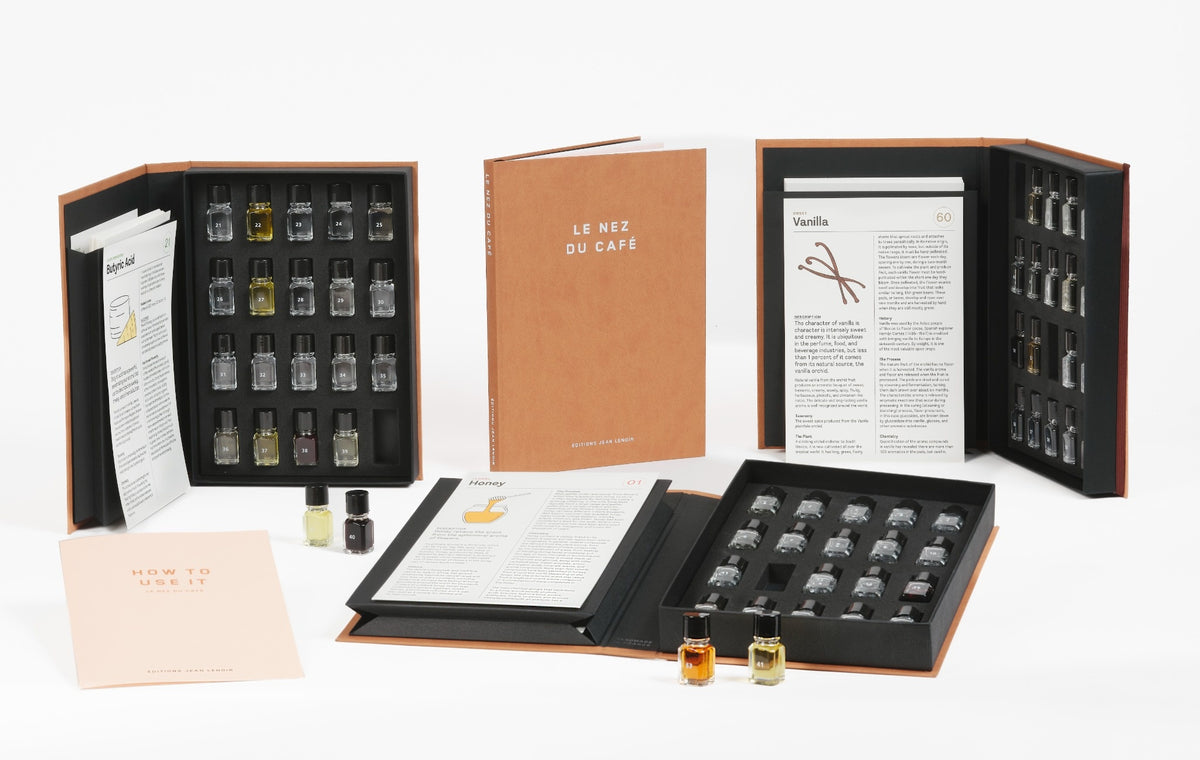
Le Nez du Café 2.0 is a professional coffee sensory training kit with 60 aroma vials, a 96-page illustrated book and a methodology aligned with SCA and World Coffee Research standards. Released in 2025 by Jean Lenoir and produced in Cassis, in the South of France, it is the most comprehensive coffee aroma training tool currently available, and the reference used by Q Grader candidates and competition judges.
Quick answer
- What it is: 60 isolated coffee aromas, aroma cards for each, and a 96-page book on aroma chemistry and sensory analysis.
- Who it is for: baristas, roasters, Q Grader candidates, competition judges, and serious enthusiasts.
- Standards: aligned with the SCA and WCR sensory lexicons, validated by the Coffee Quality Institute.
- Versus the 36: the extra 24 aromas are fermented, vegetative and processing-derived notes that matter at certification level.
- Languages: English, French and Spanish. Aromas guaranteed for five years.
What is Le Nez du Café 2.0?
 It builds on the legacy of the original Le Nez du Café — already a reference among coffee professionals — and expands it significantly, both in the number of aromas and the depth of its educational content.
Each of the 60 vials contains a precisely isolated scent corresponding to a real aromatic compound found in coffee. These are not vague impressions or synthetic approximations: each is artisanally produced to represent a specific, identifiable aroma, from the bright acidity of a washed Ethiopian Yirgacheffe to the earthy depth of a heavily roasted Robusta.
The methodology is aligned with the Specialty Coffee Association and the World Coffee Research sensory lexicon. The vocabulary and classification you learn here are the same ones used by Q Graders worldwide — which is precisely what makes the training transferable. If you are new to the idea, start with our overview of coffee aroma kits.
What is inside the kit
The box measures 31 × 17 × 25 cm and weighs 3.7 kg. Inside, the 60 vials are organised into three themed groups.
| Group | Aromas | Where they appear |
|---|---|---|
| Floral and fruity | Jasmine, bergamot, red berry, stone fruit, citrus | Light roasts, high-altitude Arabicas, natural and honey processing |
| Fermented, green and other | Fermented fruit, grass, pepper, earthy notes | Fermented coffees, under-roasted beans, specific terroirs |
| Roasted, spiced, nutty and sweet | Caramel, chocolate, hazelnut, vanilla, smoke, spice | Medium to dark roasts |
Each aroma has its own card, connecting the scent to its origin in the coffee plant, the roasting process, or the chemical compounds responsible for it. The 96-page book covers the history of coffee, the chemistry of aroma formation, the physiology of olfaction and a systematic approach to sensory analysis. It is not an encyclopedia — it is a practical guide to training your nose.
Who is it for?
Coffee professionals
For baristas, roasters, Q Graders and sensory trainers this is a genuine professional tool. Q Grader certification places heavy emphasis on sensory discrimination — identifying specific aromas, detecting defects, describing profiles with precision — and training against isolated references rather than memory alone is the most effective way to build that skill. For roasters, understanding how roast degree transforms the aromatic profile becomes far clearer when each stage can be smelled in isolation.
Specialty coffee enthusiasts
You do not need credentials to benefit. If you read tasting notes on a bag and wonder what the roaster means by peach, jasmine and brown sugar, this answers it definitively. A natural-process Ethiopian that once seemed merely fruity begins to reveal blueberry, fermented mango and hibiscus.
Gift buyers
It is an exceptional gift for anyone with a serious interest in specialty coffee. The presentation box is elegant enough to need no wrapping, and the product speaks for itself. Our gift guide covers other options for sensory-minded recipients.
How to use it
For a full walkthrough see our dedicated guide on how to use a coffee aroma kit. In short:
Work one group at a time. Rather than opening all 60 vials, move through each themed group systematically and build memory for those scents before advancing.
Smell blind first. Pick up a vial without looking at the label, inhale slowly, try to name or at least categorise it, then check. The gap between guess and answer is where learning happens.
Use the aroma cards actively. Understanding why an aroma is present — which compounds produce it, which processing or roasting conditions generate it — turns memorisation into comprehension.
Revisit regularly. One session gives interesting insights. A month of regular practice transforms how you taste.
Connect to real cups. After a session, brew a coffee and find the aromas you have just worked with. The floral and fruity group is particularly illuminating alongside a washed Kenyan.
2.0 versus the original 36-aroma kit
 The 36-aroma Revelation kit covers the core aromatic spectrum of coffee and is sufficient for most enthusiasts and for early-stage professional development.
The 2.0 goes significantly further. The additional 24 aromas cover fermented, vegetative and processing-derived notes that become important at advanced levels — particularly for Q Grader candidates, competition judges and anyone working with complex fermentation profiles. The book adds educational depth the original does not have. If you work professionally in specialty coffee, or have outgrown the 36, the 2.0 is the natural progression.
Frequently asked questions
Is Le Nez du Café 2.0 worth it if I already own the 36?
Only if you are training toward certification or working with fermented and experimental processing. The extra 24 aromas are concentrated in exactly those families. For enjoyment alone, the 36 remains sufficient.
Is it approved for Q Grader certification?
The methodology is validated by the Coffee Quality Institute and aligned with the SCA and WCR lexicons, which is why it is widely used in Q Grader preparation. The kit is a training tool, not part of the exam itself.
How long do the aromas last?
Guaranteed for five years under proper storage — vials closed promptly, away from heat and direct light. Many last considerably longer.
What languages is the book available in?
English, French and Spanish.
Does it contain coffee or caffeine?
No. The vials hold aromatic essences on a neutral base. Nothing in the kit is drinkable.
Can a home brewer get value from a 60-aroma kit?
Yes, though the 36 is the more sensible entry point. The 2.0 pays off when you are cupping regularly or buying green coffee, where the fermented and defect families start to matter.
The Jean Lenoir legacy
Jean Lenoir is the French expert who created the original Le Nez du Vin in 1981 — a wine aroma kit that became a global reference among sommeliers and educators. The concept was simple but powerful: isolate the individual scents, present them in a precise and reproducible format, and give tasters a concrete reference against which to calibrate perception. The approach proved so effective that he extended it to whisky, coffee, tea and cognac, each time with the same rigour. See the full Le Nez range, or our complete guide to Le Nez du Vin.
Available at Wine World Tasters with worldwide shipping and a 60-day return policy. Unsure whether the 2.0 or the 36-aroma kit suits you better? Contact us — we are happy to help you choose.
Share:
The Aromas of Spanish and French Wines: A Sensory Journey
The Best Gifts for Wine Lovers: A Curated Guide for Every Occasion