

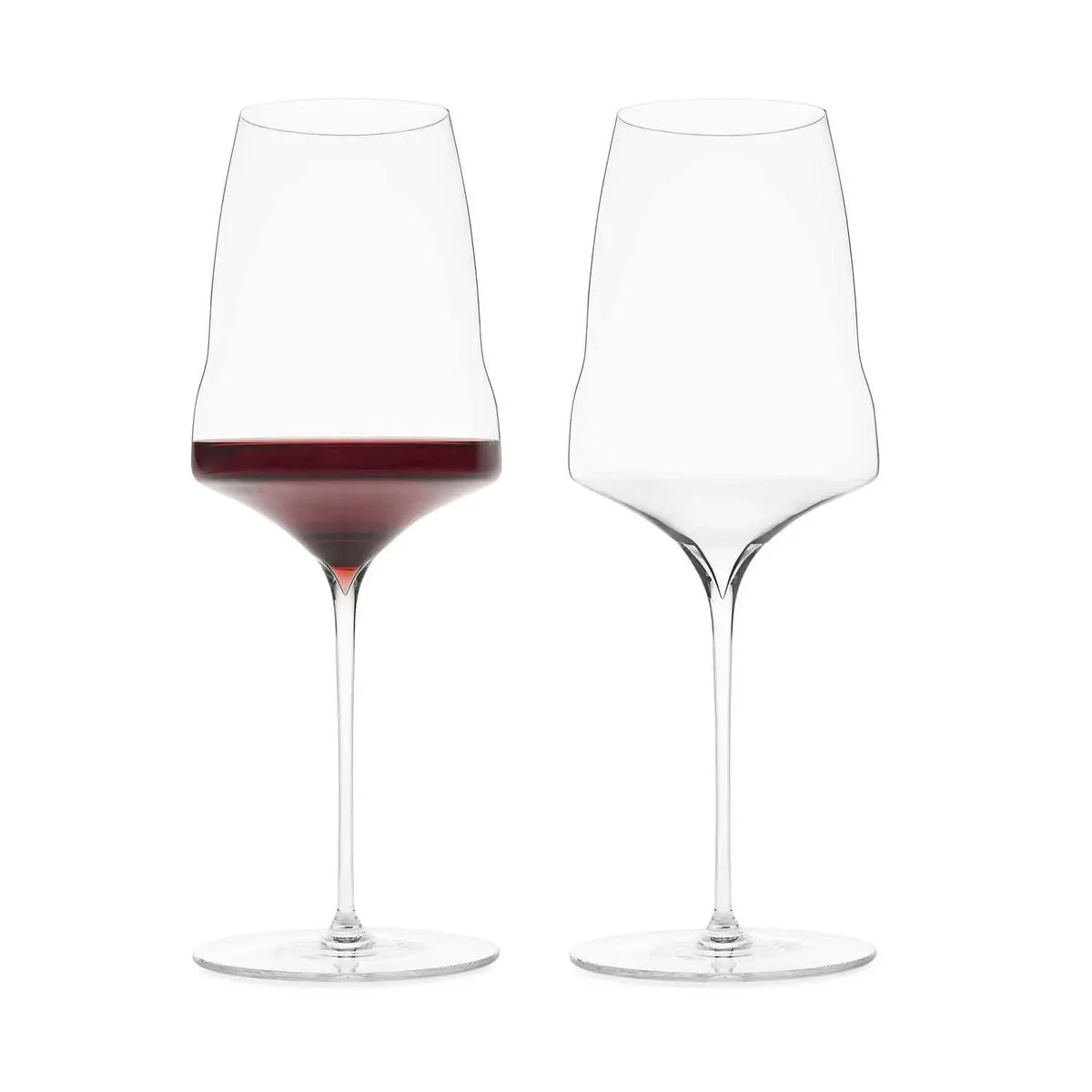
Most glassware collections ask you to choose between a Bordeaux glass and a Burgundy glass, a flute and a coupe, and hope you guess right. JOSEPHINE takes a different approach: a small, deliberate range of numbered glasses, each designed by Kurt Josef Zalto and each mouth-blown by master glassmakers in Germany's Riesengebirge.
The numbers are not a hierarchy. No 3 is not better than No 1 — they are built for different wines. This guide explains what each number is for, so you can choose the glass that suits the way you actually drink. If you want the underlying principles first — why shape changes taste, what sets handblown crystal apart — our guide to glass shapes, crystal and craft covers that ground.
No 1 — the white wine glass

The JOSEPHINE No 1 is built for delicate, aromatic whites. Its focused shape concentrates the bouquet and carries the wine's finesse precisely, which is why it excels above all with Riesling — and works beautifully with Pinot Blanc, Pinot Gris, Sauvignon Blanc, Grüner Veltliner and light rosés.
Less obviously, it is also the glass for fortified wines: port, Madeira and Sherry show their full character in it. At 550 ml it is generous for a white wine glass, which is the point — the volume gives the aromatics room to gather before the tapering rim delivers them.
No 2 — the universal glass

If you buy one JOSEPHINE, buy this one. The No 2 is the multi-award-winning universal glass: the one to reach for when you would rather not think about which glass, and still want the wine to perform at its best. It handles Pinot Blanc and Viognier as confidently as Sangiovese and Tempranillo.
It has one particular strength worth knowing. Mature reds that should not be overexposed to oxygen do better here than in a large-bowled glass — and so do high-quality vintage champagnes, which are wines first and sparkling second. For a household that drinks across the spectrum, the No 2 is the honest answer.
No 3 — the red wine glass

The No 3 is the Grand Seigneur of the collection, and it does something unusual: it combines the qualities of a Bordeaux glass and a Burgundy glass in one shape. Normally those are two separate purchases, because one is built for structure and the other for perfume.
At 800 ml the bowl gives full-bodied, concentrated reds the room they need to unfold — Pinot Noir, Bordeaux blends, Barolo, Syrah, and the great wines of the New World. It is equally at home with barrel-aged whites, which is worth remembering if you drink serious Chardonnay.
No 4 — the champagne glass

A flute displays bubbles and hides everything else. The No 4 is shaped to honour the complexity of a serious sparkling wine instead: a deeply pointed base that draws a fine, persistent bead, and a tapering rim that concentrates the bouquet towards the nose. Champagne, Sekt, Franciacorta and Cava all gain from it.
It has a second life that surprises people. Sweet wines — Auslese, ice wine, Tokaji, Sauternes — show their full splendour in the No 4, so a pair covers both ends of a meal.
No 5 and No 6 — the table glasses

Wine glasses rarely have company that deserves them. The No 5 and No 6 solve that: water glasses with the same undulating, translucent form, striking on their own and seamless beside the stemware.
The difference between them is scale and purpose. The No 5 is the compact one at 250 ml, soft and natural in the hand. The No 6, at 400 ml, is generous enough to double as a cocktail glass — the more versatile choice if your table does more than dinner. Both come in sets of six.
No 10 — the spirits glass

The No 10 is the range's answer to fine spirits. Its thin-walled curved form is inspired by a blooming flower bud, and it does three things at once: it amplifies aromatic intensity, delivers a silky mouthfeel, and softens the perception of alcohol — the single hardest thing to get right in a spirit glass.
Cognac, Armagnac, calvados and grappa are the obvious candidates. It is equally exceptional for tequila, mezcal and other fruit-forward distillates, where the aromatics are the whole point. If you already train your nose with an aroma kit, this is the glass that rewards it.
When to reach for a decanter

Decanting is two different jobs, and JOSEPHINE makes a different piece for each. For young, complex, full-bodied reds that need oxygen quickly, the Brilliant decanter is the tool: its wide base sets the wine spiralling as it pours, aerating it rapidly. The Brilliant Magnum does the same for magnum bottles and for wines that want the most intensive aeration available.
For older reds, the goal is the opposite — separate the sediment while limiting oxygen exposure. That is the Wine & Water Carafe: tall and slender, precise rather than expansive, and equally elegant for a young white or for water. It also fits in a standard fridge door, which sounds trivial until you own one that does not.
Caring for handblown crystal

The glasses are dishwasher safe, though hand washing is recommended and will keep them looking their best for longer. The decanters are the stricter case: rinse the carafe thoroughly after use and keep it out of the dishwasher entirely, while the Brilliant decanters tolerate a glass-only programme with supportive brackets.
The Linen Cloth & Brush set exists for exactly this. The Italian-made linen polishes crystal without scratching it, and the soft brush reaches the last drop inside a glass or carafe without detergent — which matters, because detergent residue is what dulls fine crystal over time.
Frequently asked questions
Which JOSEPHINE glass should I buy first?
The No 2 universal. It performs across reds, whites, rosés and champagne, so it is the one glass that never feels like the wrong choice. Add the No 3 next if you drink mostly reds, or the No 1 if you drink mostly whites.
What is the difference between the No 1 and the No 2?
The No 1 is focused specifically on delicate aromatic whites and fortified wines. The No 2 is deliberately versatile — the same height and volume, but a shape built to suit almost anything rather than to excel at one thing.
Do I need both the No 3 and a Burgundy glass?
No. The No 3 is designed to combine the qualities of a Bordeaux and a Burgundy glass in a single shape, which is why it replaces two glasses rather than joining them.
Are JOSEPHINE glasses dishwasher safe?
The glasses are, though hand washing is recommended. The Wine & Water Carafe should be rinsed by hand only; the Brilliant decanters can go in a glass-only programme with brackets.
Why is each glass slightly different?
Because every piece is mouth-blown by hand from lead-free crystal. Small variations between glasses are the signature of the process, not a flaw in it.
The logic of the range is simple once you see it: No 1 for aromatic whites, No 2 for everything, No 3 for serious reds, No 4 for sparkling and sweet, No 5 and No 6 for the rest of the table, No 10 for spirits — and a decanter chosen by whether the wine is young or old. Serving temperature is the other half of the equation; our guide to serving temperatures covers it.
Explore the full JOSEPHINE collection →
JOSEPHINE glassware is available at Wine World Tasters with worldwide shipping and a 60-day return policy. Not sure which glass suits you? Contact us — we are happy to help you choose.

Share:
Gifts for Coffee Lovers: From First Aromas to Complete Kits