
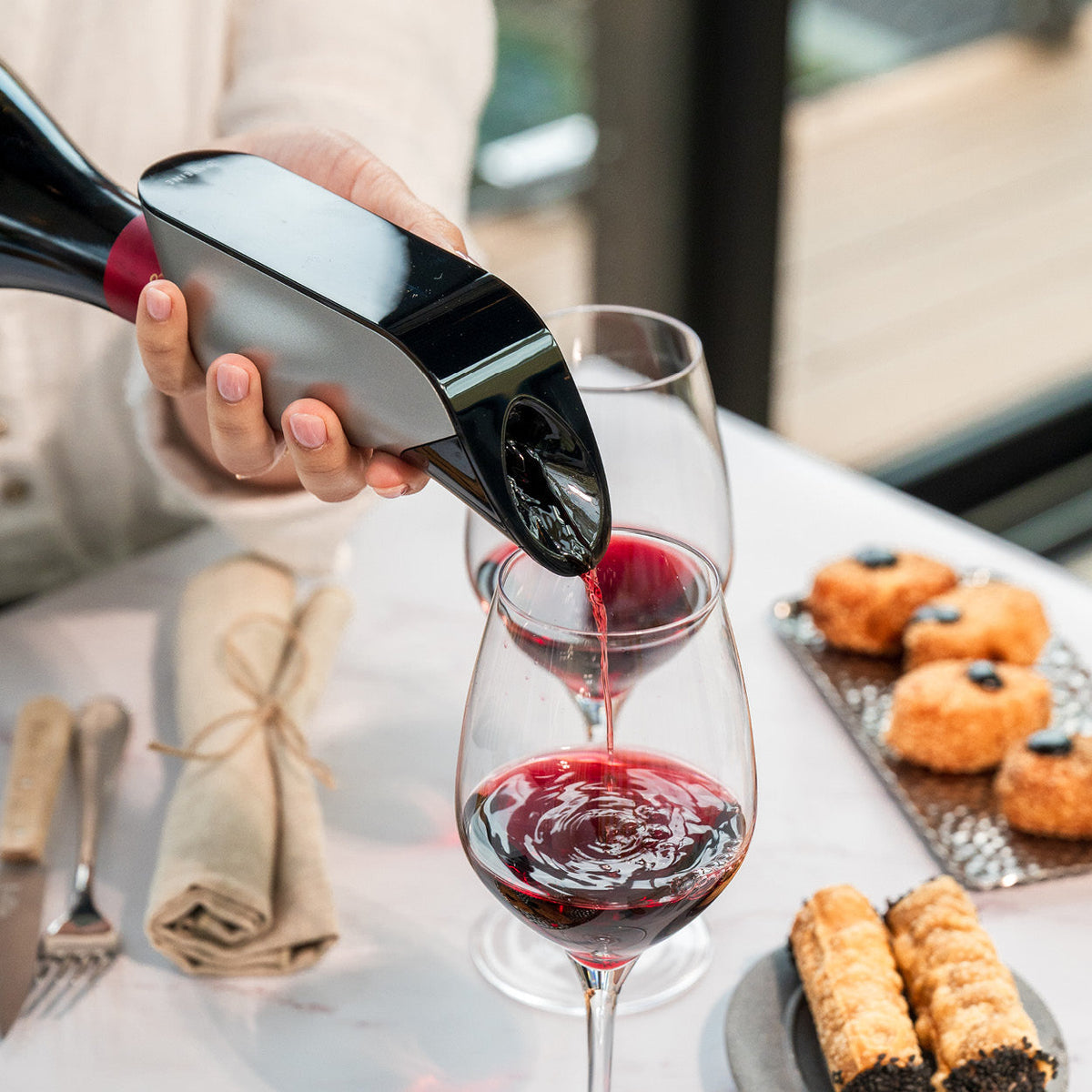
For as long as anyone has cared about wine, the answer to a closed bottle has been the same: pour it into something wide and wait. An hour. Three hours. Sometimes a whole afternoon, hoping you guessed right. The Aveine Original replaces the waiting with a number you choose.
Fit it to an open bottle, select an aeration time between 1 and 24 hours, and pour. The wine reaching your glass has been aerated for exactly that long. Not approximately, not eventually — instantly, and only the wine passing through the spout.
How instant aeration actually works

Inside the aerator is a patented micro-oxygenation system, developed from techniques borrowed from cardiac surgery. As the wine passes through, a precisely measured volume of air is injected into it — enough to reproduce what hours in a decanter would have achieved, compressed into the second it takes to fill a glass.
You set the level on the aerator's own touchscreen. Or you let the Aveine app read the bottle label and propose the ideal setting for that specific wine, which is the part that tends to win people over: the hardest question in decanting has never been how, it has been how long.
It is cordless and rechargeable, fits around 90% of standard bottles, and arrives with its charging base, travel bag and a two-year warranty. It won a CES Innovation Award and an A'Design Award in 2019.
The problem it was built to solve

To see why that matters, it helps to be honest about what decanting has always asked of you.
Air changes wine. Oxygen softens tannins, lets volatile compounds evaporate and releases aromas that were locked in. A young Barolo that tastes tight and severe on opening can become generous two hours later. That much is settled.
The difficulty is that the right amount of air is different for every bottle, and you have to commit to your guess before you taste. Decant a young, structured red for two hours and you are rewarded. Decant a fragile forty-year-old Burgundy the same way and you watch it fade in the glass — decades of development dispersed in under an hour. And once the wine is in the decanter, the decision is irreversible for the whole bottle.
How much air does each wine really need?
These ranges hold up well in practice — and they are the same numbers you dial in on the aerator.
| Wine | Air it wants | Why |
|---|---|---|
| Young, tannic reds — Barolo, Bordeaux, Syrah | 2–4 hours | Firm tannins need sustained oxygen to soften and let the fruit through. |
| Medium-bodied reds — Rioja, Côtes du Rhône, Chianti | 1–2 hours | Enough to lift the aromatics without flattening the fruit. |
| Light reds — Pinot Noir, Gamay | 15–30 minutes | Delicate structure; too much air blurs the perfume that defines them. |
| Barrel-aged whites — serious Chardonnay | 20–30 minutes | Air releases the texture and the oak-derived complexity. |
| Aromatic whites and rosés | None | Freshness is the point. Air costs more than it gives. |
| Mature reds — 15 years and older | Minutes, if at all | These wines can fade within the hour. Handle with restraint. |
| Champagne and sparkling | Never | You would be pouring away the mousse. |
Two rules carry most of the weight. The younger and more structured the wine, the more air it wants. And the older the wine, the more cautious you should be.
Three wines at one table, from one bottle

Because only the wine in the glass is aerated, the rest of the bottle stays exactly as it was. That one detail changes what is possible at a table.
The same vintage can be poured three ways for three palates: opened up for the guest who wants it generous, left untouched for the one who prefers it tight and linear. A single glass from a bottle you intend to preserve gets the air it needs without committing the remaining three quarters. And a wine you misjudged is corrected on the next pour rather than written off.
It also removes the planning. Decanting assumes you knew two hours ago that you would want this bottle tonight — which, on most weeknights, you did not.
Where the decanter still wins

An aerator is not a replacement for a decanter, and it is worth being precise about why.
Decanting does a second job that has nothing to do with air: it separates a mature wine from its sediment. For an old bottle, that is the whole reason to pour it off — and there the right tool is a tall, slender vessel such as the JOSEPHINE Wine & Water Carafe, which limits oxygen exposure rather than maximising it. Stand the bottle upright for a day, pour slowly in one movement, stop when sediment reaches the neck, and serve.
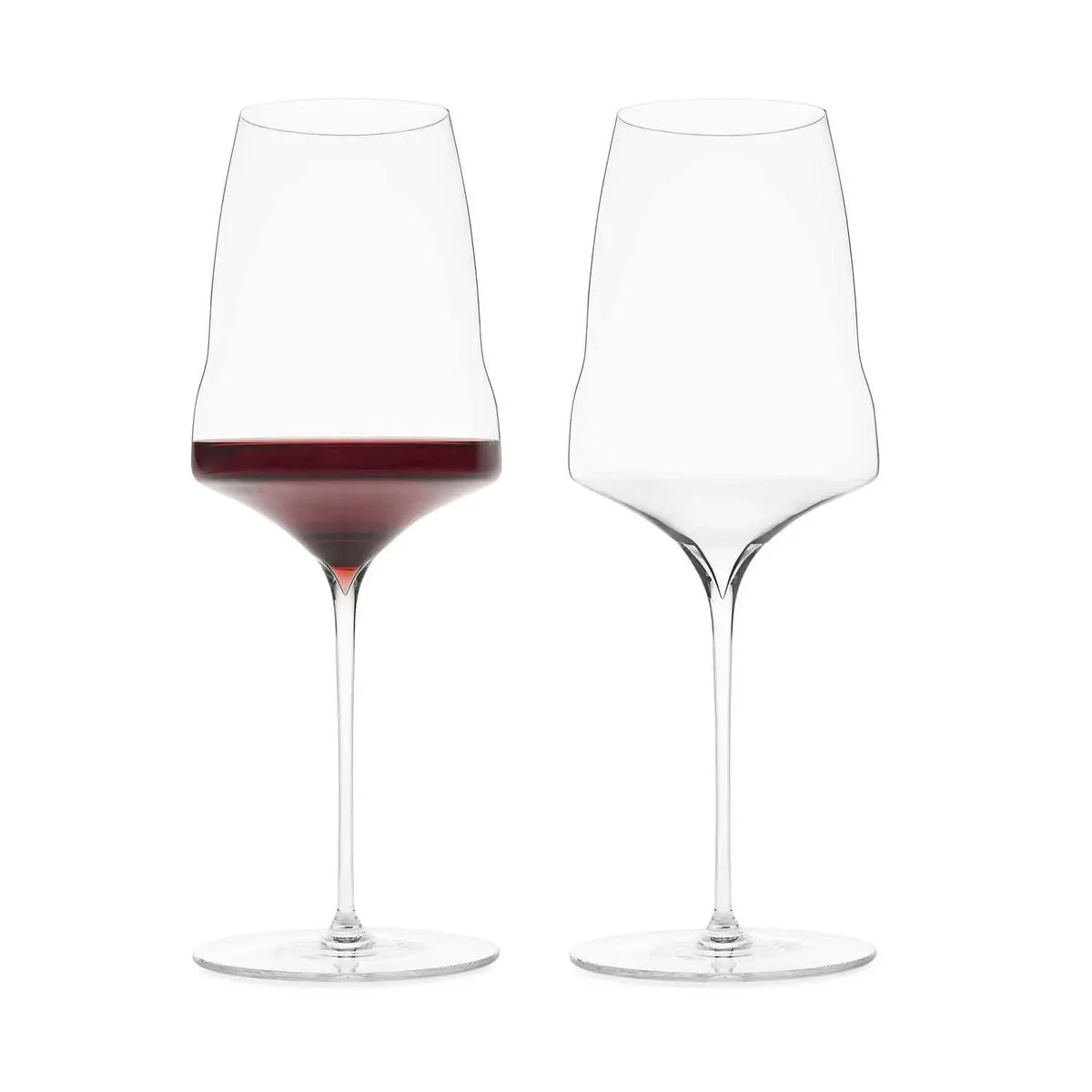
 There is also the occasion itself. A JOSEPHINE Brilliant on the table is part of the ritual, and a young, structured wine shared among friends over an evening is exactly what a wide-based decanter is for. The honest summary: the aerator is for control and immediacy, the decanter for sediment and ceremony. Most serious wine drinkers end up with both.
Frequently asked questions
Is an aerator as good as a decanter?
For aeration, it is faster and more precise — you choose the equivalent of 1 to 24 hours instead of guessing. For separating sediment from a mature wine, you still need a decanter. They solve different halves of the same problem.
Does instant aeration really match hours in a decanter?
The micro-oxygenation system injects a measured volume of air directly into the wine as it pours, which is a far more efficient transfer than wine sitting passively in contact with the air above it. That is why seconds can stand in for hours.
Can you use it on old or fragile wines?
Yes, and carefully — set a low level or none at all. The advantage with a fragile bottle is that you can taste a glass before deciding, something a decanter never allows.
Does it fit every bottle?
It fits around 90% of standard bottles. Magnums and larger formats are the exception.
Does simply opening a bottle early do anything?
Very little. The neck exposes only a few square centimetres of wine to air. Meaningful aeration needs either a large surface area or air pushed through the wine itself.
How do you clean it?
Rinse with cold water after each use to clear the tannins, then with hot water. It is not dishwasher safe.
Air is not an optional refinement — it is part of how a wine reveals itself. What has changed is that the amount is now yours to choose, glass by glass, at the moment you pour. The glass completes the job: our guide to the JOSEPHINE range explains which shape suits which wine, and our guide to serving temperatures covers the third variable, because a wine served too cold will stay closed however much air you give it.
Discover the Aveine Original →
Shipped worldwide with a 60-day return policy. Not sure what your bottle needs? Contact us — we are happy to help.
Share:
The JOSEPHINE Range Explained: Which Glass for Which Wine